
By Kelly Dean Hansen, freelance classical music writer
The first real “spaghetti western” came long before the films of Sergio Leone and the scores of Enrico Morricone. The title rightfully belongs to Giacomo Puccini’s 1910 opera The Girl of the Golden West (La fanciulla del West). No previous dramatic work by an Italian creator had made such a commitment to the portrayal of the American frontier in the mid-19th Century.
Its setting and its plot make the opera a natural fit for the summer festival in Central City, and indeed it is easy to shift the action from the California Gold Rush to the later one in Colorado, in which Central City itself was, well, central. It is staged as the 2024 season’s second production in the opera house that was built during the area’s boom.
Coming later than his big hits La bohéme, Tosca and Madama Butterfly, La fanciulla has stubbornly remained less popular than that trio, despite its containing Puccini’s most sophisticated and sweeping orchestration. It was appropriately first performed at New York’s Metropolitan Opera. This was the first world premiere of an opera there. Puccini considered it his greatest accomplishment, but critics and audiences at the time did not agree.
The reasons for this are understandable. It does not contain as many memorable melodies as the composer’s other operas, and in fact one major recurring phrase is perhaps most recognizable as the tune Andrew Lloyd Webber allegedly lifted for his Phantom’s “Music of the Night.” The score does not really have any “American” idioms, which was curious after Puccini quoted “The Star-Spangled Banner” in Madama Butterfly. And the plot is still heavily criticized today.
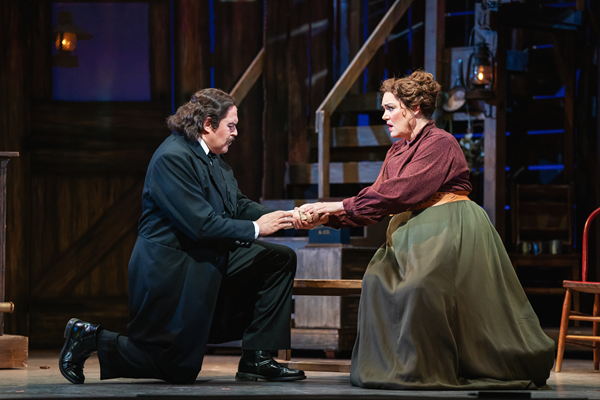
The staging at CCO makes a strong case for the opera as the masterpiece Puccini believed it to be, flaws and all. Director Fenlon Lamb gorgeously frames her cast, with its large all-male chorus, in the imaginative paper-based sets. All of them—the title character’s “Polka” Saloon in Act I, her mountain cabin in Act II, and the forest in Act III—are beautiful and realistic, with multi-level design in the first two.
That title character, Minnie, is the central role and the only large female one. She is portrayed by dramatic soprano Kara Shay Thomson, who returns to CCO as a seasoned performer at great opera houses, including the Lyric Opera of Chicago. In 2023, she was a lead in two productions at Opera Colorado in Denver, including another massive Puccini role, the title character of Turandot. In the 90s, Thomson was a Studio Artist in Central City’s Bonfils-Stanton Foundation Artists Training Program, and her career is a testament to its stellar reputation.
Thomson is not only a powerful singer, but a highly expressive actor. Her entrance in Act I is late, but grand, and from that point on, she dominates the proceedings in the best possible way. She conveys a magnetism that makes the devotion of the miners to Minnie believable, and the character’s exceedingly tender love for the outlaw Dick Johnson is palpable.
Johnson is served by the lyrical tenor voice of Jonathan Burton, whose appearances at CCO in 2016 and 2018 were also in great Italian romantic roles, Cavaradossi in Tosca and Manrico in Verdi’s Il trovatore. Burton’s voice is a wonderful match for Thomson, and their love sequence in Act II is easily the best part of the entire performance.
The antagonist is Sherif Jack Rance. Puccini treated the baritone voice more generously than he is often credited. The villainous Scarpia in Tosca, the impetuous Marcello in La Bohéme, and the benevolent Sharpless in Madama Butterfly are examples, as is the title character in Gianni Schicchi. Rance is one of his meatiest baritone roles, a villain like Scarpia, but one who manages to live and possibly repent. Grant Youngblood, who has also been a frequent performer at CCO, effectively portrays the character’s lust, both for Minnie and for vengeance.
Youngblood and Thomson have the opera’s most intense scene, the card game at the end of Act II where the stakes are Minnie’s honor and Johnson’s life. That tension is viscerally felt as they deal out the hands, the text partly spoken over the ominous beating of the timpani.
All the male supporting cast is excellent, including bass-baritone Christopher Job, making his CCO debut as Wells Fargo agent Ashby, and former apprentice artist baritone Matthew Cossack as the tender-hearted Sonora. Studio artist tenor Nicholas Lin stepped in admirably to cover Brian Downen as the bartender Nick in the opening performance on July 6. Apprentice artist baritone David Drettwan has a gentle ballad as Jake Wallace in Act I.
The only other woman in the cast is apprentice artist mezzo-soprano Natacha Cóndor as Minnie’s Native American housemaid Wowkle, who sings a lovely lullaby to her baby at the beginning of Act II, joined by her betrothed Billy Jackrabbbit (apprentice artist bass-baritone Steele Fitzwater).
The chorus of miners, some of them named, is filled out by other apprentice and studio artists. The chorus is particularly impressive in the climactic forest scenes of Act III. Visiting conductor Andrew Bisantz discreetly leads the CCO orchestra through the difficult score, and as always, the musicians play impeccably in the pit.
Despite Lamb’s best efforts, the plot’s inherent weaknesses are not quite overcome. The transition between Act II and Act III is problematic. Why is Johnson on the run again after Minnie’s deal and card game with Rance? Apparently that deal did not cover Wells Fargo. Johnson’s alleged dalliance with a “woman of ill repute” is also never adequately resolved. But this Fanciulla is gorgeously played, sung, and staged in what is clearly a perfect venue.